
From drawing to support
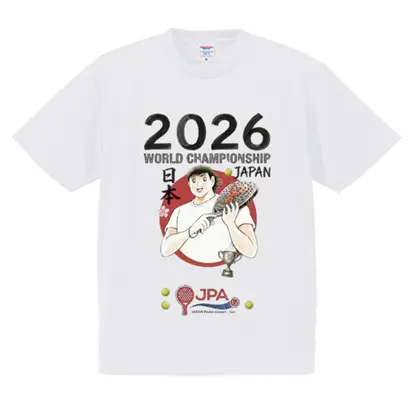
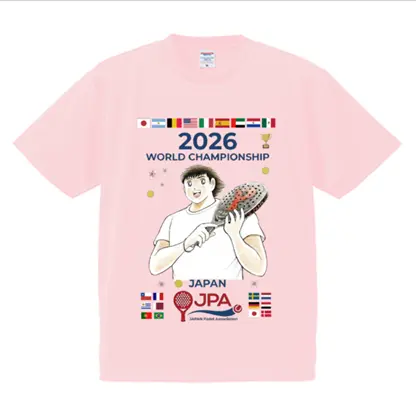
On the white shirt, an illustrated player holds a padel racket beneath the words ‘2026 World Championship’. On the pink version, national flags frame the same world of competition and representation. Published by the Japan Padel Association (JPA), these product images present something to wear and a way to take part: a share of the price is intended to help Japanese representatives travel abroad. The garment offers a concrete starting point for understanding connections between creativity, local play and support for the game.
A garment to help fund departures
Launched on 1 July 2026, the Padel Support T Project is organised by the JPA itself. Its announcement sets out a monthly series, with the first edition supervised by Yōichi Takahashi, the creator of Captain Tsubasa and the association’s honorary president.
The stated price is ¥5,000 including tax. Under the announced arrangement, at least ¥1,500 per shirt is intended to support Japanese representatives’ travel costs. The initial target is 3,500 shirts in 100 days, corresponding to around ¥5 million in support. These are announced targets, not a sales or payment report.
The association also chose 7 July, Tanabata, to communicate the project’s purpose. It explicitly connects the festival of wishes with players’ ambitions and the support it wants to gather. That choice gives the launch a place in the Japanese calendar.
Takahashi’s relationship with the game predates the shirt
The manga artist’s involvement did not begin with this campaign. The JPA announced his appointment as honorary president from 22 April 2019. At the time, it said he had discovered padel in Spain and played about once a week. That frequency describes the 2019 announcement; it is not a verified account of his current routine.
The relationship also has an address: Captain Tsubasa Padel in Chōfu, western Tokyo. The club’s website links the use of the work’s name to Takahashi’s wish to introduce more people in Japan to the sport. It records an opening in August 2022 and a four-court grand opening in September 2023.
This is a documented connection between manga and padel: a person who plays, an association and a venue. It does not establish that the manga’s popularity caused a measurable rise in participation. For the shirts, the JPA specifies supervision; the exact creator of the designs still needs confirmation.
The story in motion
The Reel selected for this article
Instagram publication selected by Anthony Pastre, embedded from its source. The editorial team could not view its content.
Watch the Reel on Instagram ↗An organised scene whose reach still needs measuring
The JPA was established in June 2016. Its presentation brings together participation, training, competition and international representation. It also states an ambition to reach one million players by 2030. That ambition is not the current number of players.
On 30 October 2026, its homepage displays 25 venues and 50 courts, without specifying the reference date for that count. It would be unwise to treat it as an exhaustive, up-to-date national census. The association’s directory does, however, identify specific places and offers.
The sources show an organisation and local initiatives. They cannot establish the social profile of all Japanese players, club attendance or nationwide adoption of padel.
At a tennis club, on a rooftop or in a resort
The directory presents several settings. Padel Tokyo sits within Zenpukuji Park Tennis Club. Tokyo Mizumachi’s courts are described as close to several stations and Tokyo Skytree. In Nagoya, the offer combines padel and barbecue in a building in the Ōsu shopping district.
In Sakai, Padel One Shinkana is presented on the rooftop of the Frespo Shinkana shopping centre. In Niseko, PADEL+ appears within HANAZONO resort. These are different venues whose uses and audiences need reporting; they do not define a single Japanese model.
For MPI, these distinct settings matter more than a uniform image of the country. The game finds a place within tennis facilities, commercial settings and holiday destinations. How each venue relates to its neighbourhood remains a story to report on the ground.
Meals and meet-ups are part of the offer too
The JPA’s guide to getting started describes events pairing play with food: ‘niku-pade’ around meat, ‘padellia’ around paella, and winter gatherings featuring nabe or oden. It also mentions early-morning padel and Halloween events.
These examples show how the association presents opportunities to gather. They do not establish their current frequency in each club or national popularity. Their cultural interest lies in the attention given to meals, timing and the format of an encounter, alongside court time.
Chigasaki Padel Club offers a more specific example of joining a group: its website lists individually bookable, coach-free playing sessions on Saturdays and Sundays from 1pm to 3pm for people who can already play. It also says non-members may rent courts. Arriving alone can therefore be an organised route into play.
Learning, finding equipment and returning
At Padel Tokyo, the offer includes regular classes, junior categories, introductory sessions and equipment hire. Booking arrangements include telephone, email and LINE. Learning is therefore connected to practical services that make another visit possible.
This lets us describe routes into play without inventing a typical Japanese player. Trying the sport at an event, booking with friends and taking lessons are different offers. Available sources do not tell us their respective shares or how many people continue playing.
Wearing support: what the T-shirt adds
Within this scene, the clothing project offers a role alongside playing or watching: buying and wearing a sign of support. The JPA presents the shirt as a tangible record of contributing to funding. The link between drawing and sporting travel takes a simple form: a garment sold, a stated contribution towards a journey.
The dedicated website also presents September editions, with a dog motif supporting the men’s team and floral compositions supporting the women’s team. These designs should be distinguished from the first edition supervised by Takahashi.
The financial report remains the missing piece. The pages consulted do not establish how many shirts have sold or how much money has actually been distributed. The shirts, venues and gatherings already give this padel culture visible forms; players’ accounts and the project’s follow-up will help establish their reach.
A garment sold, a stated contribution towards a journey.
Sources
- JPA — T-shirt support project, launched 1 July 2026 ↗
- Project website — designs and funding mechanism ↗
- JPA — Takahashi appointment, 22 April 2019 ↗
- Captain Tsubasa Padel — Chōfu club ↗
- JPA — about the association ↗
- JPA — venue directory ↗
- JPA — events, court hire and lessons ↗
- Chigasaki Padel Club — activities and entry ↗
- Padel Tokyo / Padel Asia — lessons and access ↗
- JPA — homepage and displayed figures ↗