Connections as the starting point
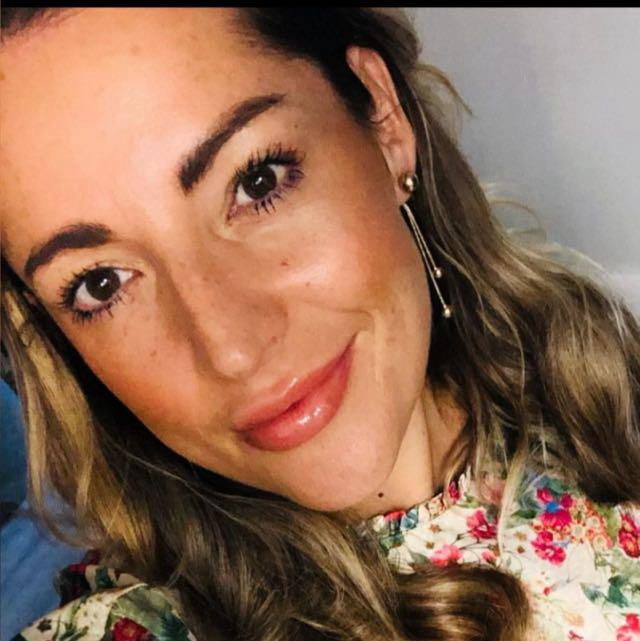
In early 2023, Aimée Lawson discovered padel in Manchester with her sons. They had tried tennis, but found it difficult to play together. On a padel court, they immediately found a sport they could share. For someone with twenty years of experience in marketing, brand experiences and partnerships, that first session also opened a new professional field.
Her attention turned to everything happening around the game: people meeting, staying at the club, creating content or starting a project together. Those exchanges are where she locates the origins of Eutopia Group, which brings together Eutopia Agency and EutopiaConnect. The latter is a platform designed to connect players, agents, brands, clubs and events. In this interview, Aimée says the waitlist is open and the launch is planned for October 2026.
Following Twenty4 Studios in episode 001, Iconic Conversations continues to explore the people working around padel. For this second conversation, Make Padel Iconic asked Aimée Lawson eleven questions about her journey, her projects and the place of human relationships in the sport’s development. Her written answers are published below in their original language. The projects and perspectives described are those presented by Aimée at the time of the interview.
The story in motion
Iconic Conversation #002 — the Reel
The Reel accompanying this second Iconic Conversation, also available on Instagram.
Watch the Reel on Instagram ↗Could you introduce yourself and tell us about your journey before leading Eutopia Group?
I’ve spent the last 20 years working in marketing, brand experience and partnerships, mostly around the intersection of brands and people.
I started my first business in Australia, an experiential marketing agency, after spending eight years in London working with global marketing agencies. Since then I’ve worked across a broad range of brands and experiences — from Jaguar Land Rover customer experience days at race tracks, to Samsung sponsorship activation with the Australian Diamonds, and projects involving brands such as Microsoft, Google, Nike, adidas, Gucci, Patrón and Aperol.
What has always interested me is how you take a brand and create something people actually want to be part of. That’s probably the thread that connects everything I’ve done.
Eutopia came from bringing that experience into the world of padel.
How did you first get involved in the world of padel?
My boys and I discovered padel in Manchester in early 2023. We’d previously tried tennis, but it was difficult for all of us to play together. Padel changed that. It was accessible from the first session, naturally social and gave us a sport we could enjoy as a family.
I started looking at what was happening around the sport and the trajectory was pretty obvious. Clubs were opening, participation was growing and there was something happening culturally around padel that felt bigger than the sport itself.
Coming from a brand and marketing background, I became fascinated by the opportunity.
What I didn’t expect was how much padel would open up for me personally and professionally. I’ve built relationships and opportunities through the sport that I simply wouldn’t have encountered otherwise.
It’s led to agency work, athlete partnerships and new ventures. I’m Founder of Eutopia Group Ltd which comprises EutopiaConnect and Eutopia Agency. EutopiaConnect is a platform connecting players, brands, clubs and events; Eutopia Agency helps brands build relevance, create attention and grow in padel through strategic marketing, creative and commercial partnerships.
For me, that’s part of what makes padel so interesting. You start with a sport, but the connections around it can take you in completely unexpected directions.
Why did you choose to work around this sport rather than another?
Because I don’t think padel behaves like a traditional sport.
It has sport at its core, but around that you’ve got friendship, community, fitness, wellness, hospitality, travel, fashion, content and increasingly culture.
People don’t just play and leave. They meet people, stay afterwards, eat, drink, create content and build relationships.
That creates a really interesting environment for brands, but also for athletes, creators, clubs and events.
I also came into padel at a relatively early stage, which meant there was an opportunity to help shape what the culture around the sport could become rather than simply following an established playbook.
What did you immediately see in padel: an economic opportunity, a social phenomenon, a new creative territory, or a combination of all three?
I probably saw the social phenomenon first, followed by the new creative territory. I also saw something much bigger in it — the potential for sport to play a role in tackling some of the challenges we’re facing around loneliness, inactivity and health.
Padel gets people moving, but it also gets people together. You can turn up without knowing anyone and very quickly find yourself part of a community. For me, that combination of physical activity and human connection is incredibly powerful.
The commercial opportunity came very quickly afterwards, and then I realised just how much creative territory there was around it.
Three years ago, most of the brand managers I was speaking to hadn’t even heard of padel. Today, brands are actively writing padel into their marketing strategies.
The conversation has completely changed.
What’s interesting is that the growth isn’t just about more people playing. It’s about more people wanting to be part of the world around padel.
That’s where I think the really exciting opportunity sits.
What role does Eutopia aim to play in the development of padel?
Initially, Eutopia was focused on helping brands understand and activate within the padel sector. But as the sport has grown, the commercial landscape around it has changed dramatically.
We’re seeing major global brands move into padel, from Rolex and On working with Arturo Coello to Heineken 0.0 becoming a Global Beer Partner of Premier Padel, while WHOOP has entered through a three-year global partnership that also includes direct sponsorship of selected players and coaches.
At the same time, there are smaller racket, apparel, footwear and lifestyle brands emerging all over the world. They’re looking for players to represent them, create content, produce UGC, appear in campaigns and shoots, test products and become part of their brand story.
Then you’ve got clubs and events looking for professional players for exhibitions, clinics, appearances and other activations.
I experienced that demand first-hand.
As I started working with professional players, I was increasingly coordinating these opportunities for them — finding the right brands, working out who was a good fit, managing introductions and trying to keep track of everything that followed.
And I kept thinking: there has to be a smarter way to connect the right players with the right opportunities, wherever they are in the world.
That’s really where the idea for EutopiaConnect came from.
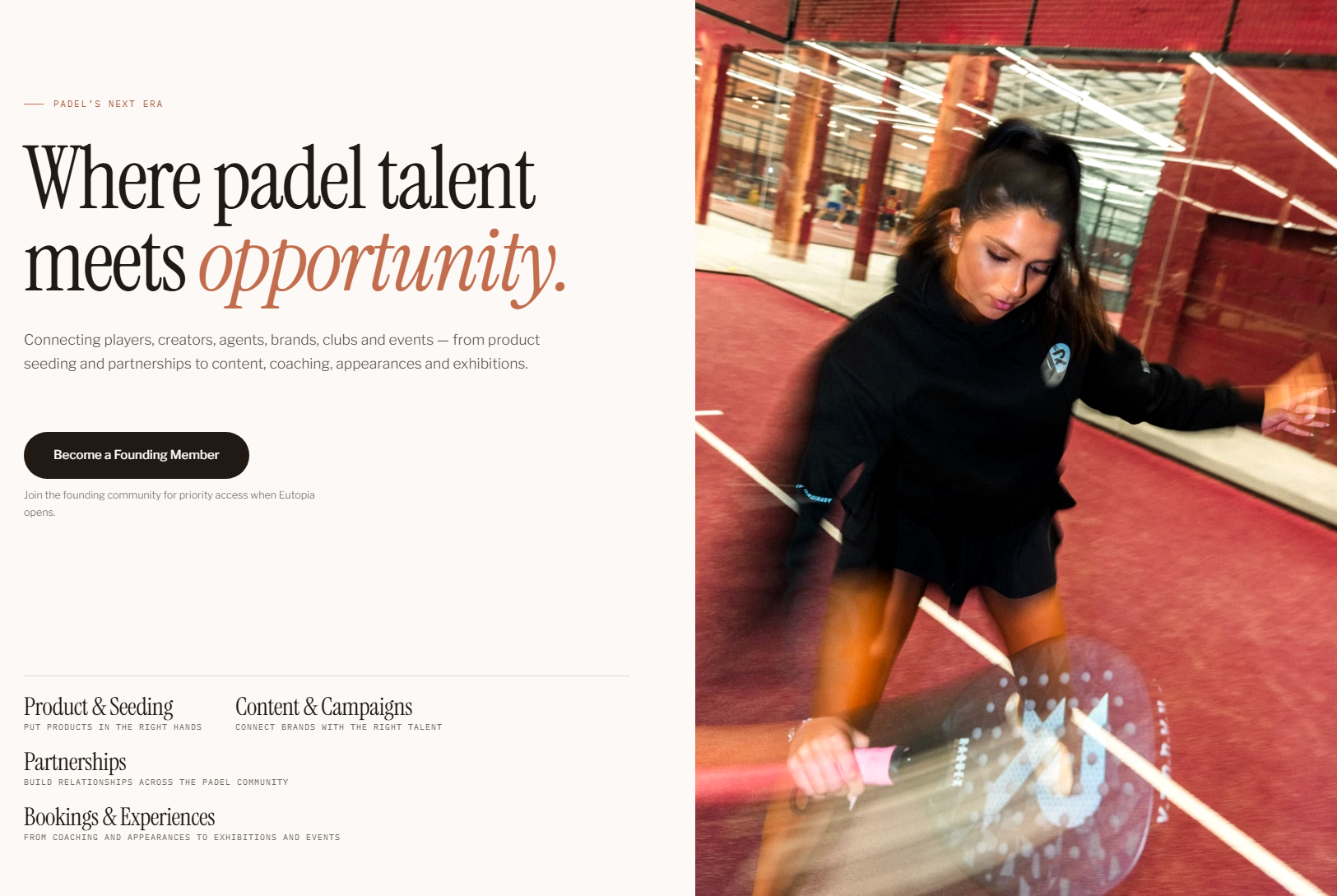
EutopiaConnect is a platform connecting padel players, agents, brands, clubs and events.
For players and creators, EutopiaConnect is about turning their presence in padel into real opportunity — helping them build their personal brand, grow their audience, become commercially discoverable and create new ways to earn from the sport they love.
Our proprietary software analyses a player’s profile, social presence, audience and activity to help them understand where they are now, where their potential lies and what they can do to become more commercially valuable. Rather than having to figure out how to market themselves, grow their following or approach brands, players get personalised insights, recommendations and a bespoke social media strategy built around them.
Players can create a professional profile that brings together their playing experience, rankings and achievements, skills, personality, content, audience, existing partnerships, availability and commercial interests. The platform then uses this information to help match them with relevant brands, clubs, events and opportunities.
They can discover opportunities that fit who they are — from sponsorships and brand partnerships to content, product collaborations, events, coaching and appearances — and manage the journey from discovery through to deal and delivery in one place.
The goal is to give every player the tools and intelligence to understand their value, build their profile, get discovered and unlock more opportunities through padel.
Players can create and share a professional media kit, giving brands, clubs and events a much clearer picture of who they are and what they can offer.
We’re also building the infrastructure around the opportunity itself — including contracting and the commercial workflow — so the process can move from discovery to deal in one place.
For agents, that means EutopiaConnect can become a practical tool to develop, represent and commercialise their athletes, rather than another platform they simply have to maintain.
It can help them maintain and strengthen athlete profiles, manage media kits and credentials, build their athletes’ personal brands and visibility, identify relevant opportunities, put the right players forward, manage commercial enquiries and track opportunities and relationships.
The bigger idea is to take what is currently a fragmented, relationship-led process and make it much more connected, transparent and scalable.
For a player, that could mean discovering a brand in another country that is a perfect fit. For a brand, it could mean finding the right athlete without already having a relationship with them. For a club, it could mean finding a professional player for an exhibition or clinic. And for an agent, it could mean managing all of those opportunities across their roster in one place.
The waitlist is currently open, and due to launch in October.
Ultimately, we want to make the commercial side of padel much more connected. If you’re a player, brand, club or event and you want to find your next opportunity in padel, I want EutopiaConnect to be one of the first places you go.
In your view, what makes padel particularly interesting for brands, creators, and new communities?
It’s incredibly accessible.
You don’t have to be an elite athlete to participate, and that completely changes the type of community you can build around a sport.
You’re bringing together professional players, amateur players, entrepreneurs, families, young and older generations, creators and increasingly celebrities — and they can all occupy the same space.
For brands, that’s incredibly powerful because you’re not just buying media against an audience. You’re becoming part of a community.
For athletes and creators, there’s also a huge opportunity to build a much broader identity around themselves.
We’re already seeing players become content creators, entrepreneurs, ambassadors and business owners. They’re no longer just athletes being sponsored; they’re becoming media channels and brands in their own right.
I think we’re only at the beginning of that.
Is there a project or encounter that particularly represents your vision of padel?
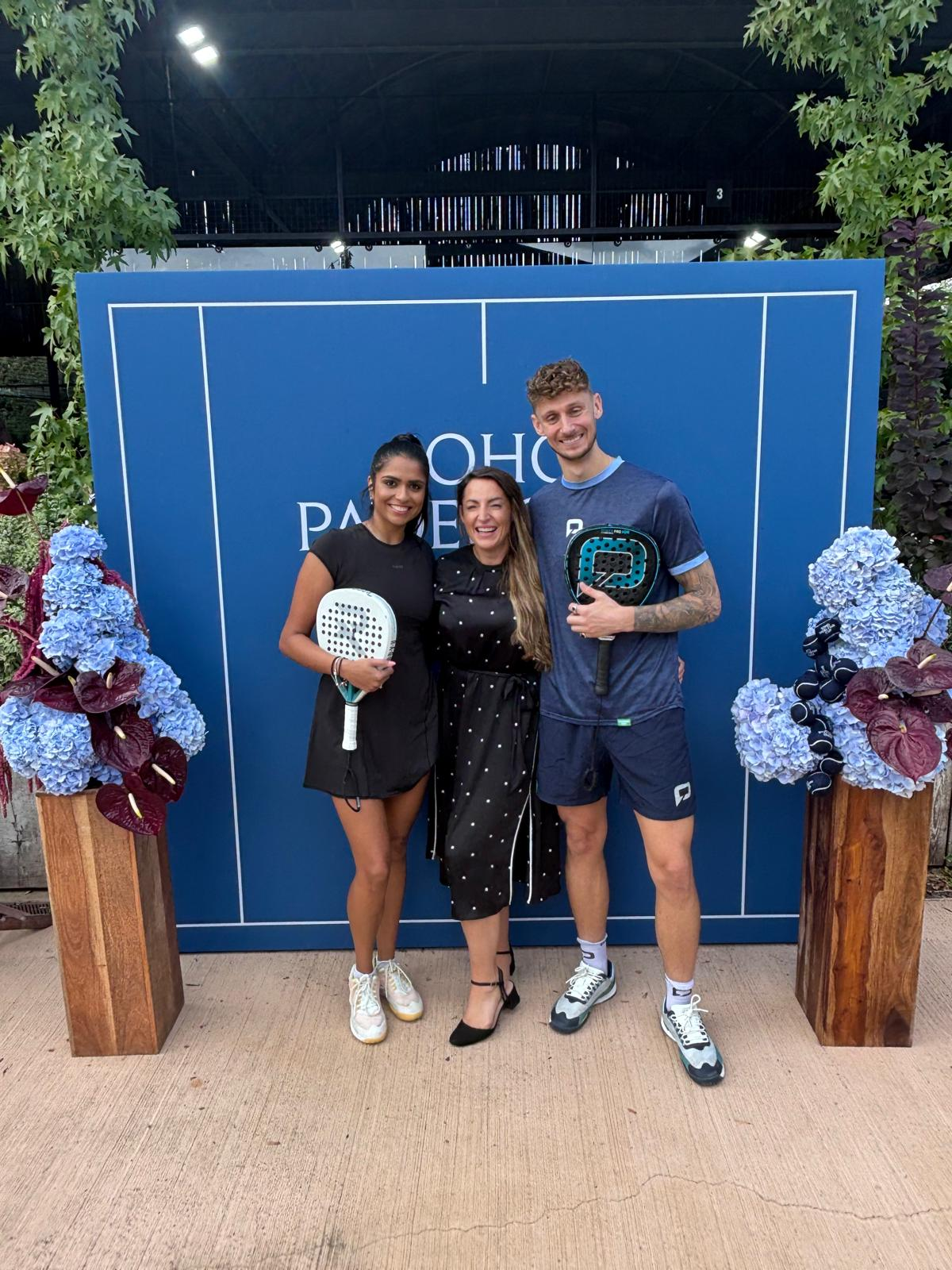
The work I’ve done with Jasmine Dedakia and George Weller probably represents it particularly well.
We started working with Jasmine, the UK No. 2, and brokered her long-term racket partnership with Raquex, who went on to win Best Racket Brand at the British Padel Awards earlier this year. With George, we started working together last year and helped secure him a place playing at the Soho Padel Cup, which is where his and Jasmine’s off-court relationship really flourished.
They’re both incredible humans, and that’s actually what matters most to me. We share a very similar vision of life and business — around respect, values, integrity and doing things properly. The relationships have developed naturally from there, rather than being purely transactional.
That’s also a big part of how I see the future of padel. It’s not just about rankings, results or sponsorships. It’s about the people behind the players, the relationships they build and the opportunities that can come from putting the right people in the right environment.
Jasmine and George are now the founding athletes of EutopiaConnect, which feels like a natural extension of everything we’ve been building together.
The Soho Padel Cup is a good example of what I mean. A tournament can create an environment where two people meet, connect and build a relationship that has nothing to do with what happened on court. A player partnership can turn into a friendship. A friendship can become a business relationship. A club can become a community. A player can become a creator, entrepreneur, mentor or brand ambassador.
You can’t always predict what will come from those interactions — and that’s exactly what makes the padel ecosystem so interesting to me.
That’s the ecosystem I’m interested in building around EutopiaConnect: creating the connections and opportunities that happen when the right people find each other.
Do you see differences between the way padel is developing in England and internationally?
Definitely.
I’ve lived in Australia for eight years, and Australia is an incredibly sports-mad country. Sport is deeply embedded in everyday culture, so that has definitely influenced how I look at the opportunity.
The UK is developing quickly, but every market is creating its own version of padel.
Spain has the heritage and depth of participation. France is developing a really interesting club and lifestyle culture. The UK has a huge opportunity to create something distinctive of its own. And Australia has a very strong natural connection between sport, lifestyle and community.
I’m particularly interested in what happens when those different cultures start influencing each other.
For me, Eutopia was never going to be a single-market proposition.
The opportunity is global, but I think the best ideas will come from understanding what makes each market different rather than trying to impose one model everywhere.
How would you like to see padel culture evolve over the next few years?
I’d like to see padel become much more than a sport that happens to be growing quickly.
I’d like it to develop a cultural identity of its own.
That means better clubs, stronger communities, more interesting brand partnerships and more opportunities for athletes and creators.
It means fashion, design, music, hospitality, wellness and art becoming part of the ecosystem — not because padel needs to borrow credibility from other industries, but because it naturally lends itself to those worlds.
I’d also like to see athletes given more freedom and opportunity to build something around who they are.
And I think we need to be careful not to commercialise the soul out of the sport.
The reason people love padel is fundamentally human. It’s social, inclusive and fun.
The challenge now is to grow the industry without losing that.
On a more personal note, what does padel represent to you today?
It still represents connection.
It started with my boys. We found a sport we could all play together, and that experience opened the door to an entirely new world for me.
What I couldn’t have predicted was how many doors padel would subsequently open professionally as well.
I’ve met players, founders, club owners, brands, creators and entrepreneurs through the sport, and some of those relationships have led to partnerships, businesses and opportunities I never would have expected.
That’s what keeps me excited about padel. You never quite know who you’re going to meet, what you’ll learn from them or what might come from that connection.
And perhaps that’s why Eutopia feels like such a natural extension of what padel has given me personally.
Finally, what does the phrase “Make Padel Iconic” inspire in you?
For me, it’s about making padel meaningful, not simply making it bigger.
The growth is already happening. The interesting question now is what we do with that growth and what kind of culture we build around it.
Making padel iconic means giving it a distinctive identity of its own — something that exists beyond the court and becomes part of people’s lifestyles.
And I think the next chapter is going to be about the people and connections that form around the sport just as much as the sport itself.
The reason people love padel is fundamentally human. It’s social, inclusive and fun. The challenge now is to grow the industry without losing that.