
Philippe-Chatrier is no longer just a court
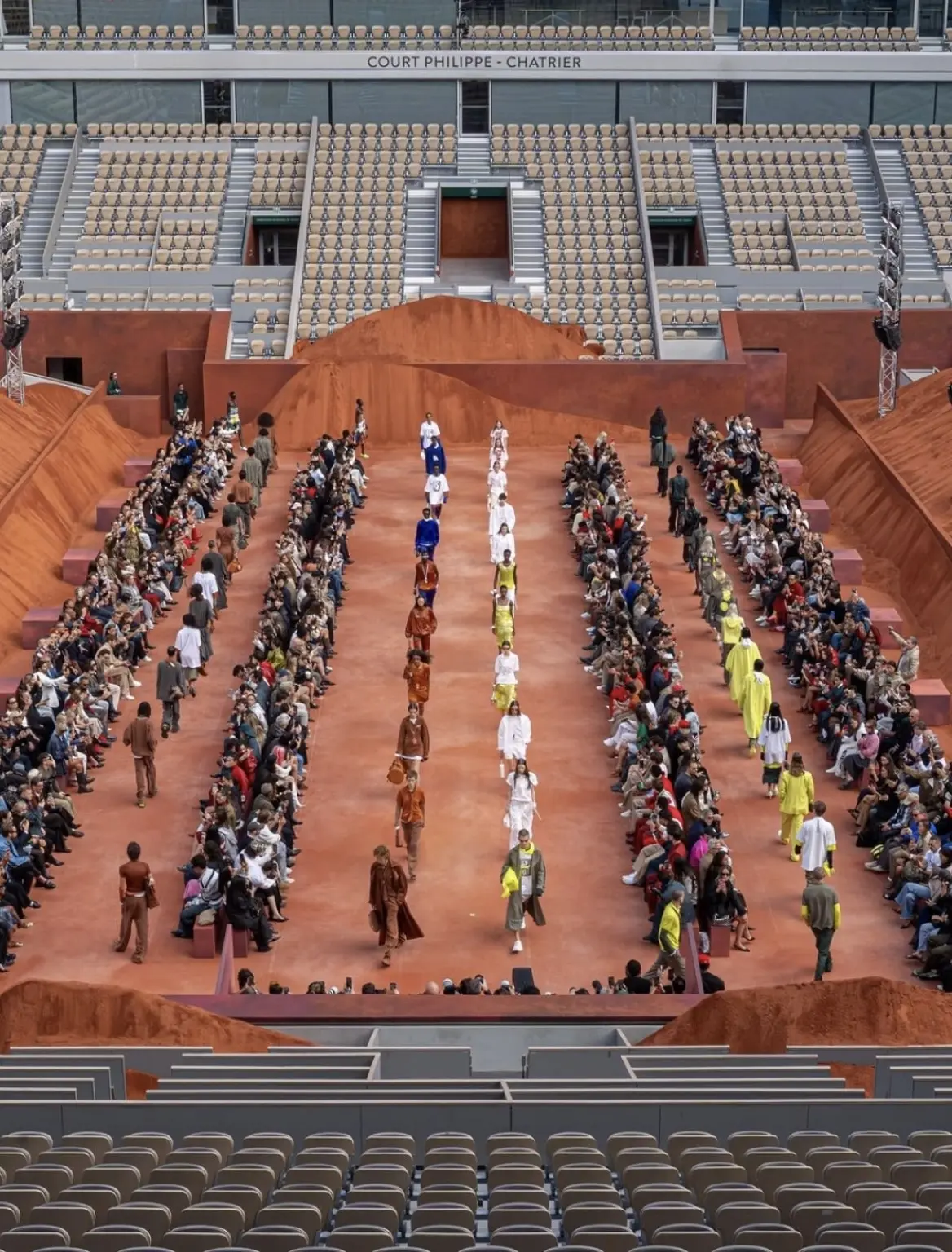
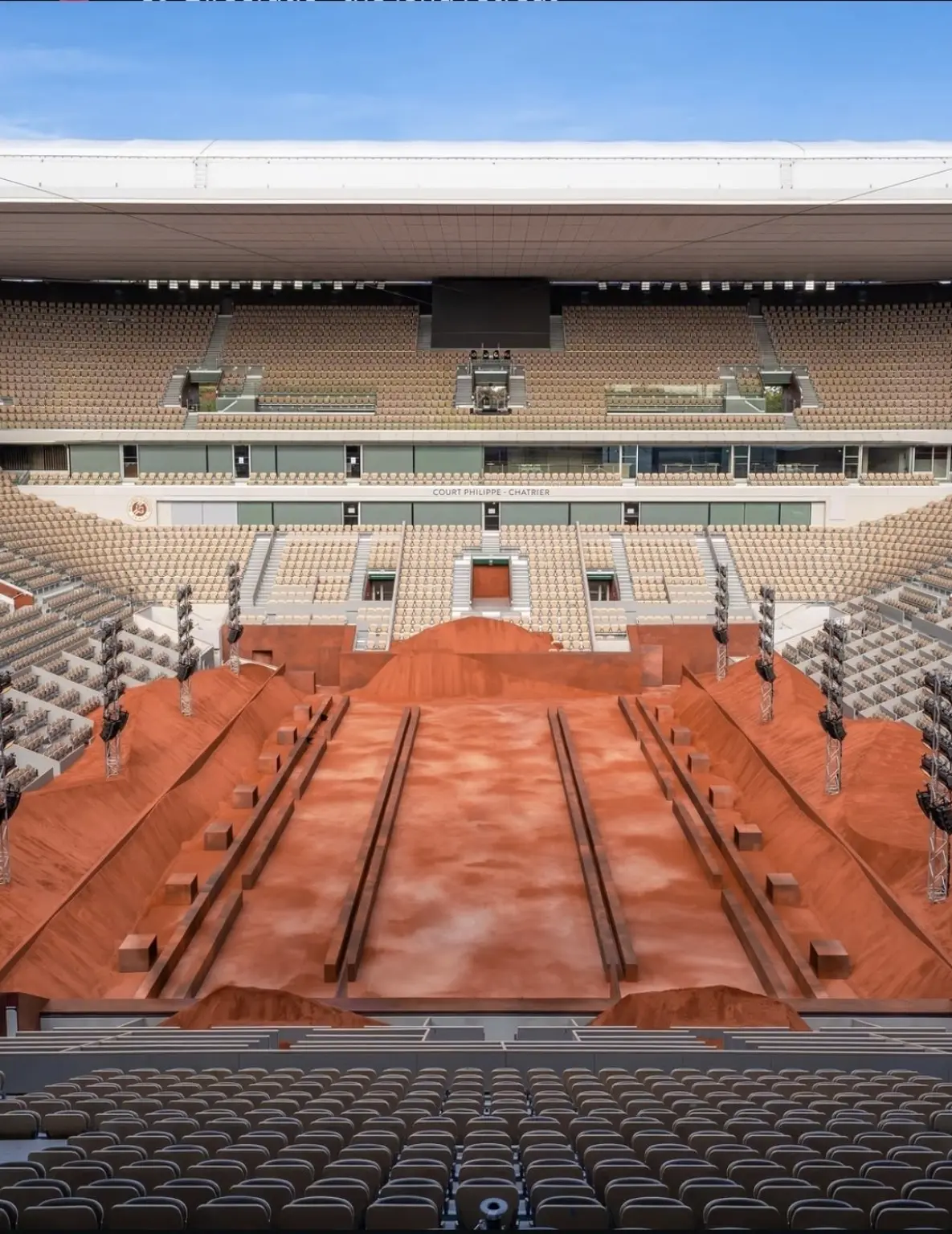
On 4 October 2026, Lacoste presented its Spring–Summer 2027 collection on Roland-Garros’ Philippe-Chatrier court. The venue did not simply host a succession of looks: ochre landforms surrounded the runway, clay appeared to spill into the stands and the models followed an infinite loop across the surface.
The scenography made it seem as though the clay had overflowed the court. That was precisely the collection’s message: a language born in tennis that now refuses to remain inside the lines of play. The stands, net, ball, polo shirt, colours and even the traces left by physical effort became material for fashion.
Pelagia Kolotouros titled the collection “Dress Code: No White Required”. Tennis white remained, but shared the stage with olive, cobalt blue, silver, fluorescent ball green and, above all, the burnt shades of clay.
The story in motion
Dress Code: No White Required
Lacoste’s official Reel presents the Spring–Summer 2027 collection designed by Pelagia Kolotouros on Roland-Garros’ Philippe-Chatrier court.
Credit : Lacoste / @lacoste
Watch the Reel on @lacoste ↗A front row that widens the court again
The front row extended this movement from sport into culture. Adèle Exarchopoulos, Camille Cottin and Pierre Niney formed a trio closely associated with French cinema, joined by creator Lena Mahfouf. Their presence immediately positioned Lacoste beyond fashion and tennis audiences alone.
The guest list was international too. Uma Thurman, Adrien Brody and actor Antonio Cipriano attended, while Venus Williams embodied an especially strong connection between competition, style and a champion’s ability to build an image far beyond results.
Each personality carries the silhouettes, shoes and setting towards a different community. Tennis leaves Philippe-Chatrier not only through the clothes worn by the models, but also through the people who came to watch them.
Sportswear often begins with liberation
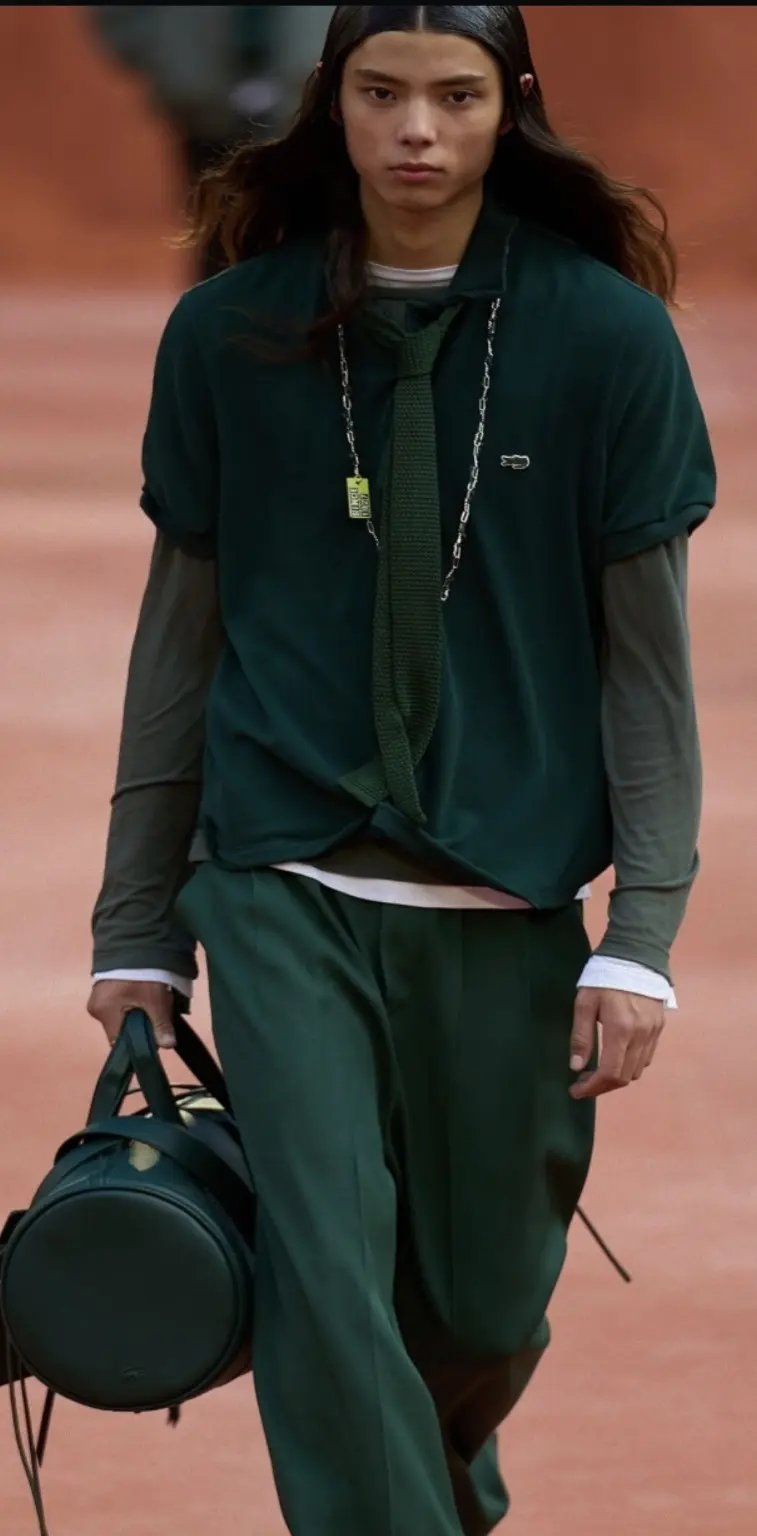
Lacoste does not invoke tennis history merely to produce nostalgia. The collection recalls two changes in clothing that first altered how the game was played, then transformed how the sport was seen.
In the 1920s, Suzanne Lenglen played without a corset, wearing short sleeves and a pleated skirt that gave her more freedom of movement. René Lacoste later shortened the sleeves of the regulation shirt and adopted a softer, lighter petit-piqué jersey. The polo introduced in 1933 first answered a practical problem: moving more freely and coping better with exertion.
What began as a technical solution gradually became a silhouette, then a social sign. The polo no longer needs a court, racket or score to be recognised. This is one of sports culture’s most powerful mechanisms: an object designed for play becomes a way of presenting oneself to the world.
The ACE-T1 turns impact into silhouette
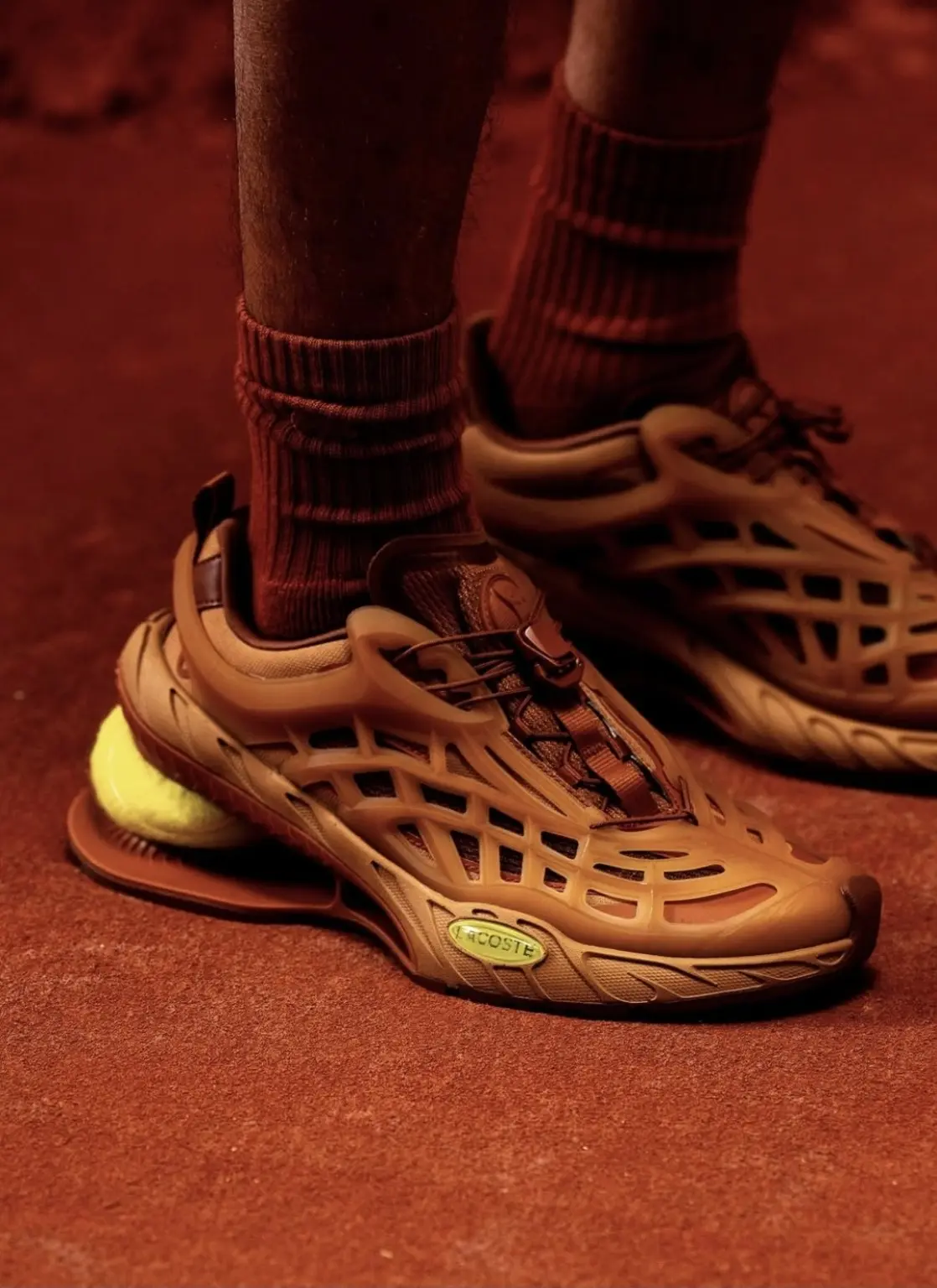
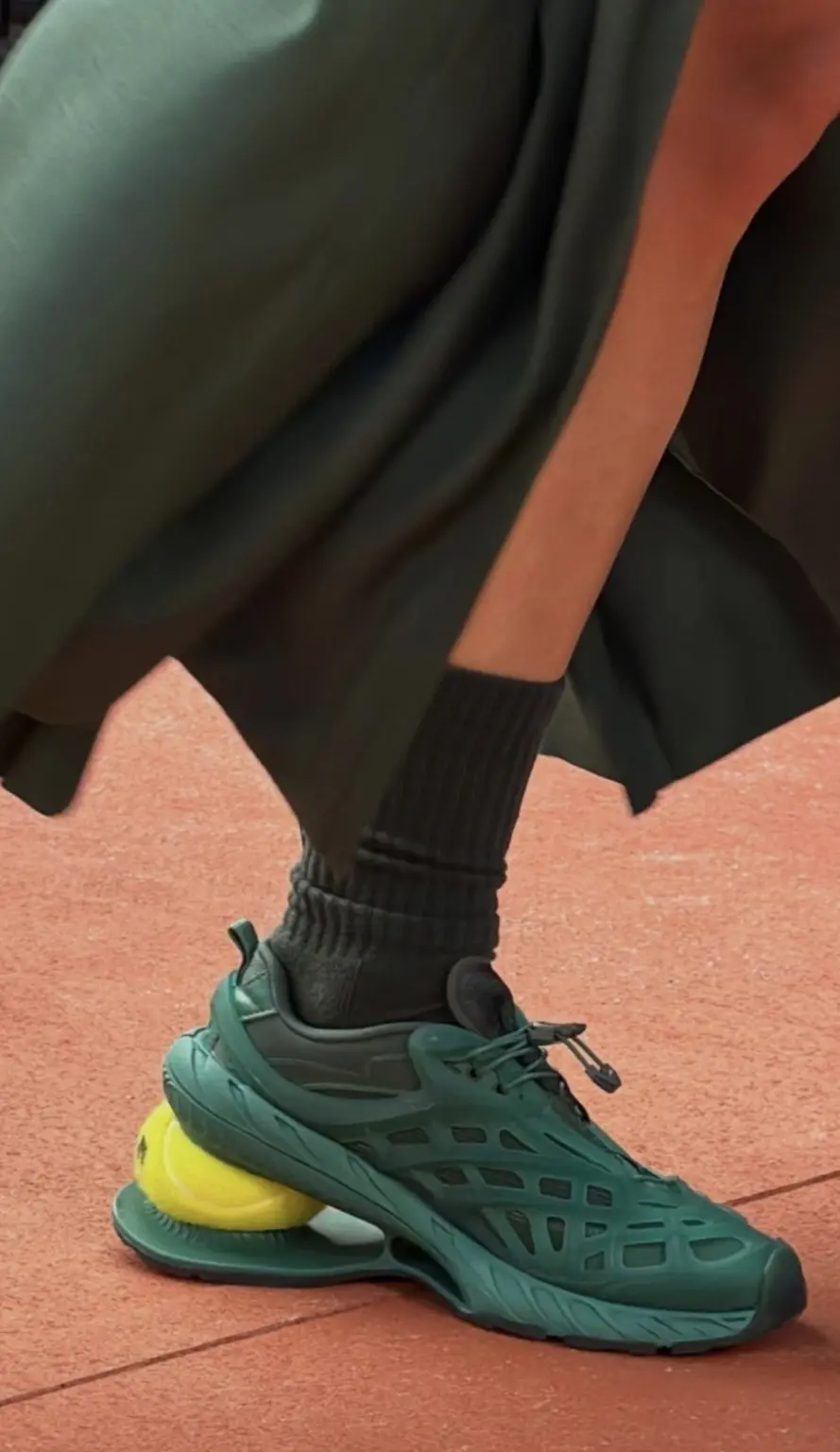
The show’s most immediate piece is found at the models’ feet. The new ACE-T1 is wrapped in a mesh cage inspired by the way a net deforms when struck by a ball. At the rear, the heel incorporates a yellow tennis ball that remains visible from every angle.
The shoe does not simply add a sports logo to an existing shape: it turns two parts of the game — net and ball — into architecture. Tension, impact and rebound directly shape the object’s volume.
Shown in white, green, silver and clay-like tones, the ACE-T1 gives tennis a form that can be worn without imitating a player’s kit. Lacoste announced three expressions: a sneaker, a tennis-ball wedge and a lace-up pump.
The ball beneath the heel makes the reference instantly legible and creates an image strange enough to circulate far beyond Lacoste’s usual audience. Whether object of desire, design conversation or Fashion Week archive, tennis travels with it.

Wearing the sport without having to play it
Performance produces powerful moments, but they remain tied to a calendar. Clothing carries sport into everyday life: on the underground, at work, at a concert or in a neighbourhood thousands of miles from where the game began.
Most people wearing a Lacoste polo are not playing tennis that day. Yet they still carry part of its vocabulary: movement, the crocodile, colour, the collar and an idea of French sporting elegance. Clothing turns a practice into a shared language.
Lacoste itself cites successive appropriations: the tennis sweater adopted by British casuals and American preppies, the polo embraced by French rap in the 1990s, and the pleated skirt becoming a garment of freedom beyond the court. Culture spreads when different groups give its signs new meaning.
The court becomes a cultural landscape
At Roland-Garros, clay is no longer only the surface that slows the ball and stains clothing. It becomes a colour, a texture and almost a mental landscape. The final white looks appeared to have been pressed against the court, their marks suggesting sweat, pressure and contact with the ground.
Fashion does not reproduce a match literally; it extracts sensations from it. It can make visible the sound of impact, the tension of a net, dust on a sock or the mark left by a moving body. Sport becomes a reservoir of images and materials, rather than merely a source of logos.
Roland-Garros and Lacoste share a history connected to René Lacoste and the Four Musketeers. By placing Fashion Week inside Philippe-Chatrier, the brand does not leave tennis behind: it reveals everything tennis can contain when viewed differently.
What padel can learn from it
Padel is still looking for the signs that will make it recognisable away from the court. It already has a distinctive racket, glass walls, identifiable clubs and a strong social dimension. Its cultural wardrobe, however, remains more open.
Lacoste’s example does not mean padel should copy tennis or multiply logo-led collections. It shows that a sport gains presence when its objects translate a real experience: a seam recalling glass, a material evoking artificial-turf sand, or a shoe turning a technical constraint into a visible signature.
To move beyond play, padel will need clothing and objects desirable enough to be worn by people who are not heading to a court. That is when its colours, forms and attitudes continue to circulate through the city.
A ball beneath the heel, a sport beyond its lines
Lacoste’s Spring–Summer 2027 show is spectacular because it transforms Roland-Garros into a landscape. It is even more culturally compelling because it does not treat heritage as a static display.
The polo is reworked, white is challenged, clay imprints the garments and the ball becomes part of the shoe. Each element leaves its original function without entirely losing its sporting memory.
The ACE-T1 sums up the whole proposition: a shoe that cannot be separated from tennis, yet does not need to step onto a court to exist. Sport supplies the gesture and material. Fashion gives them a second life.
A sport truly enters culture when its signs continue to circulate after the match is over.
Sources
- Lacoste — défilé printemps-été 2027, Dress Code: No White Required ↗
- Lacoste — Reel officiel du défilé printemps-été 2027 ↗
- Vogue France — analyse de la collection Lacoste printemps-été 2027 ↗
- Vogue France — Adèle Exarchopoulos, Camille Cottin, Pierre Niney et Lena Mahfouf au défilé ↗
- Madame Figaro — les personnalités présentes à Roland-Garros ↗
- Lacoste — histoire du polo et de la relation avec Roland-Garros ↗
- Lacoste — du sport aux différentes cultures vestimentaires ↗