
A scenario of broader participation
In France, a club opening still feels like an event. In Spain, a padel court can be an ordinary neighbourhood sports facility. That difference suggests a possible direction: a game available close to home, without every session having to become a special outing.
This is the scenario we favour here: wider participation, more affordable access and clubs becoming less dependent on tournaments to bring people through their doors. It does not assume that every operator will succeed. It assumes the sport can keep expanding even when a game no longer commands a price supported by a shortage of courts.
Padel can become cheaper to play and occupy more space in people’s lives.
Reading the FIP report
Presented on 12 October 2026, the International Padel Federation’s report brings together participation, infrastructure and economic data. The following pages are particularly useful for understanding this scenario. Page numbers refer to those printed in the report.
Pages 14–15 and 22–23: most players do not live by the rankings
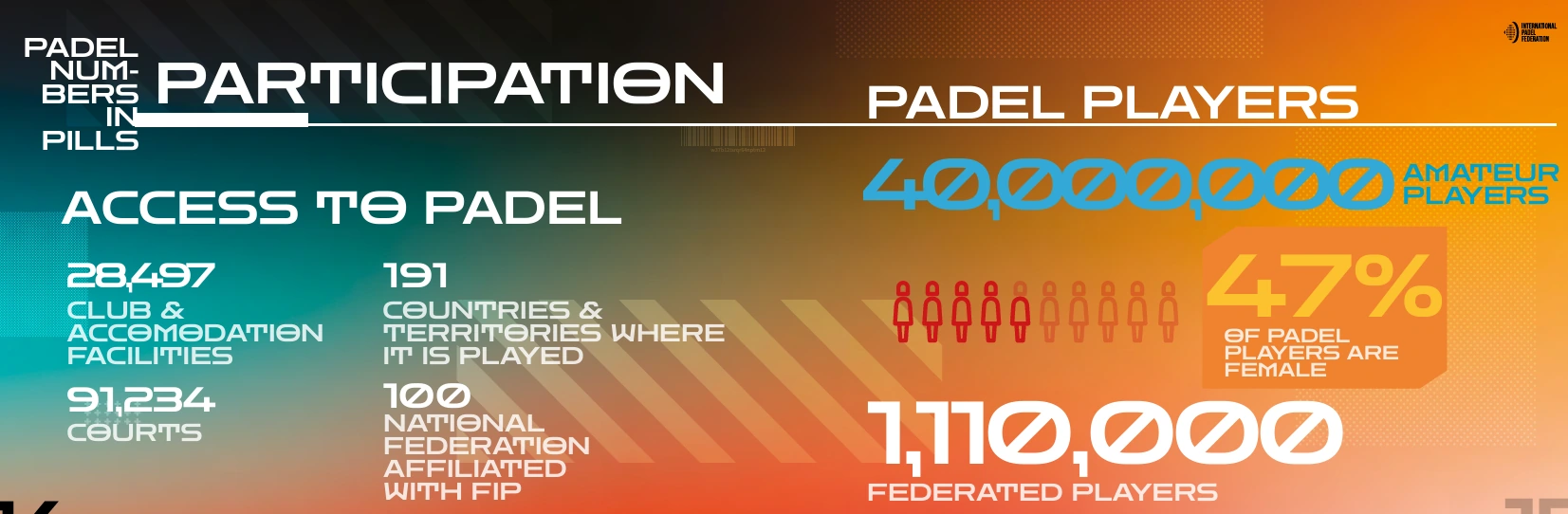
The report estimates that 40 million people played at least once during the year, including around 27 million who played more frequently. Women represent an estimated 47% of participants. There are approximately 1.1 million licensed players. These populations use different definitions.
The gap matters. Much of the playing public does not organise its week around a federation ranking. Those players may still enter recreational competitions. A club’s audience can therefore extend well beyond its licensed competitors.
Pages 28–31 and 38–39: Spain is still building
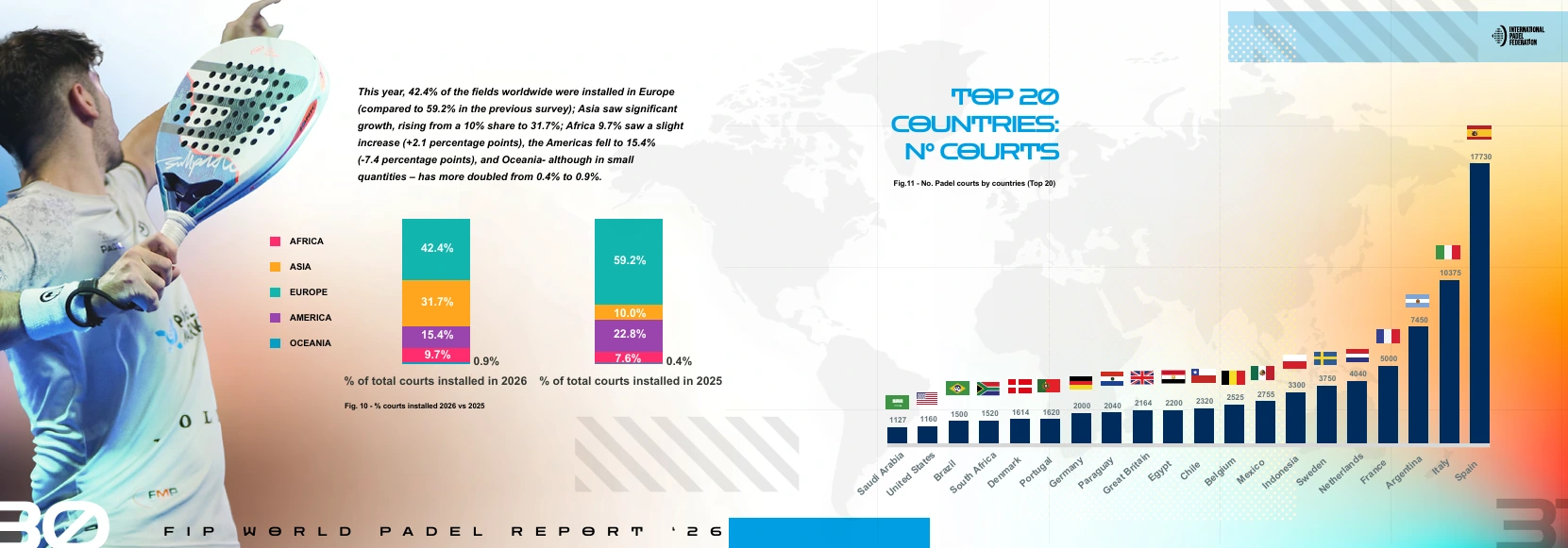
FIP counts 17,730 courts in Spain, 10,375 in Italy, 5,000 in France and 3,750 in Sweden. Its growth table records 392 additional Spanish courts against its 2025 base and projects 3% growth over the full year in 2026. France remains in a different phase, with 889 additional courts recorded and projected annual growth of 28.8%.
An established market does not necessarily stop building. Needs can shift towards other towns, less well-served neighbourhoods or better facilities. The report similarly locates more Italian construction in small and medium-sized towns than in major cities.
Pages 28–31 and 44–47: expansion reaches beyond the established markets
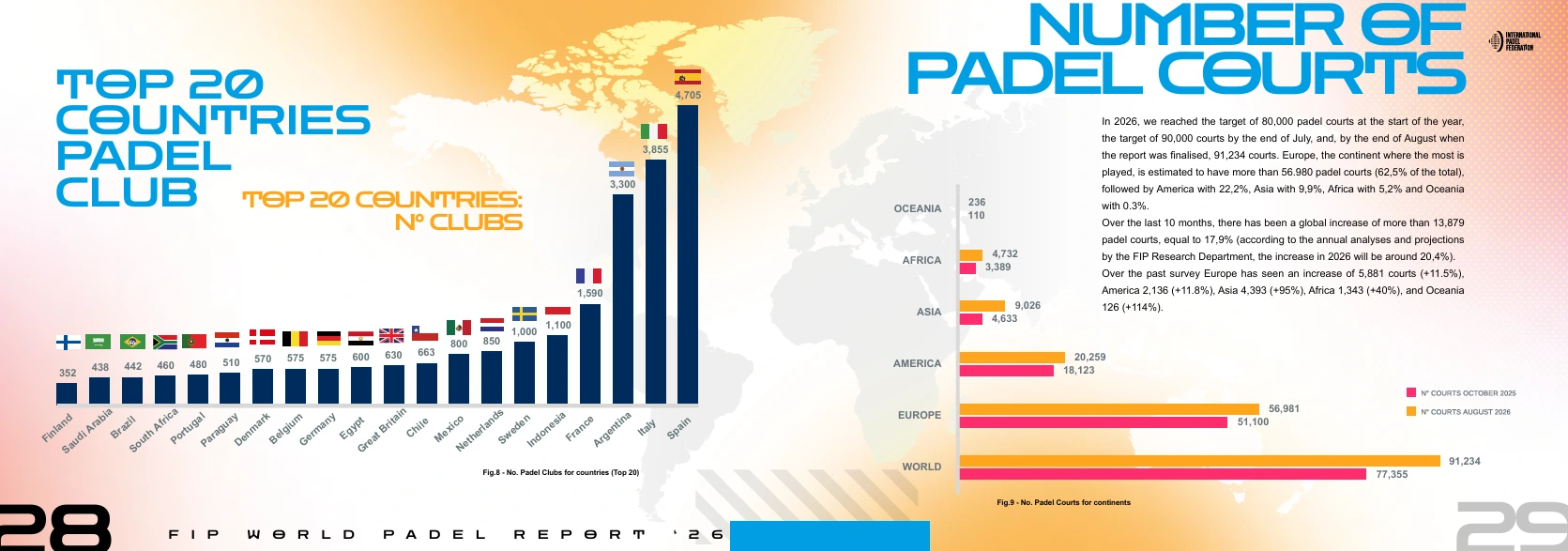
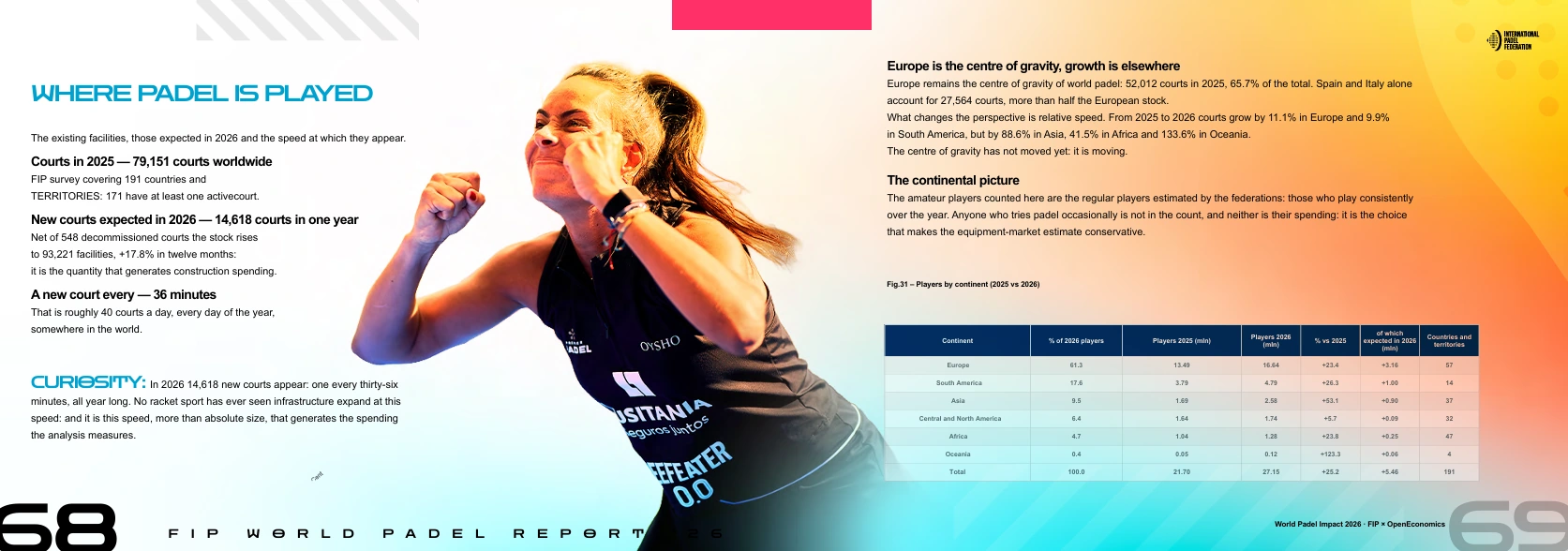
The report counts 91,234 courts worldwide at the end of August 2026. Between its two surveys, Asia adds 4,393 courts, almost a third of the global increase. Europe still contributes the largest absolute increase.
Some destinations are developing highly visible experiences. Elsewhere, the next step is regular local participation. Tourism, household incomes, transport and prices prevent one trajectory from describing every country. The comparison between surveys is not a complete calendar-year total.
Pages 72–75: ordinary games remain central
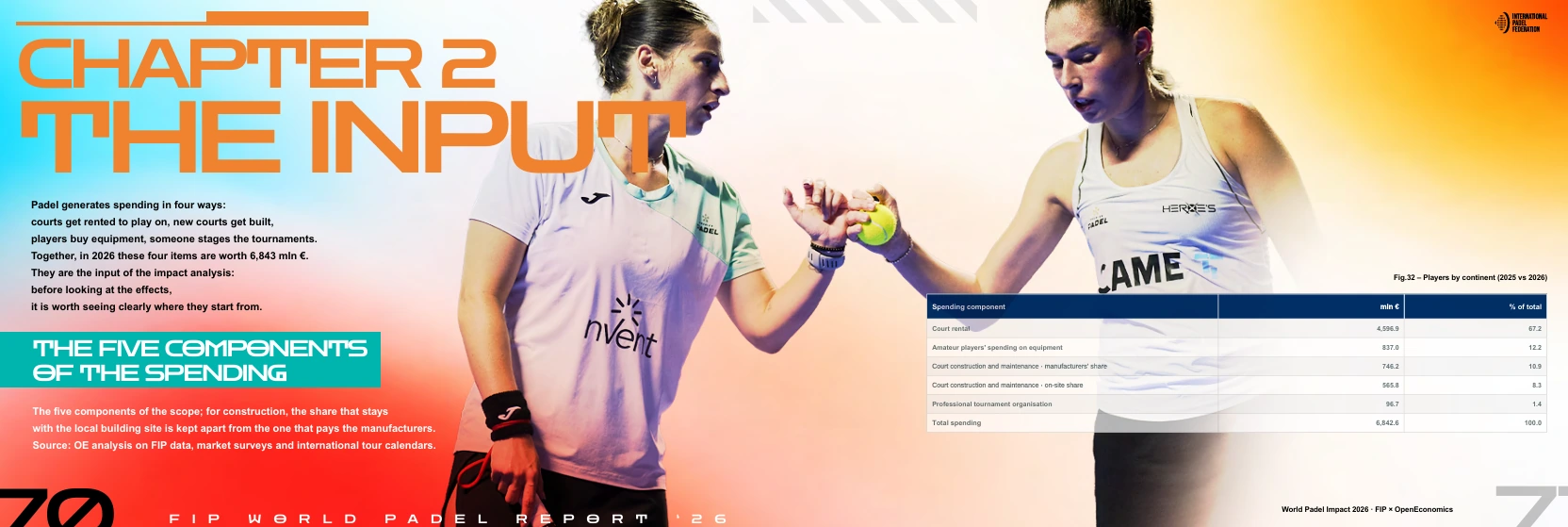
Court rental accounts for roughly two-thirds of the spending reconstructed in the FIP × OpenEconomics study. Staging the international tournaments included in the analysis represents 1.4%. This does not measure all club tournaments or the entire padel economy: coaching, sponsorship, subscriptions and sports tourism are among the exclusions.
The point is that much of the sport’s activity rests on what players do between major events. Their ordinary games and regular appointments matter over time.
In Spain, padel can already be a neighbourhood facility
Madrid’s municipal La Elipa sports centre includes six padel courts alongside other facilities. At Puerta de Hierro and Canal de Isabel II, the Madrid federation lists rental at €5 an hour on weekdays from 9am to 2pm and €10 an hour later in the day and at weekends, with a separate lighting supplement of €3.75 an hour. These are court prices, not per-player prices.
These examples document an affordable offer within a wider sports network. They do not describe every Spanish club or establish a nationwide collapse in rental prices. We do not have a consistent price series that would support that claim.
A municipal court may operate under different conditions from a privately financed indoor club. Both can nevertheless contribute to the same local playing ecosystem.
Players can choose a simple, affordable game close to home, then visit a club for its partners, coaching, atmosphere or events. A cheaper game may need less of a special occasion to happen.
Lower prices can make room for another weekly session, a first game with colleagues or family participation. Proximity and available partners matter too. But affordability can bring padel within budgets that a premium-only offer struggles to reach.
Why construction can continue under pressure on prices
Spain retains the largest court stock while continuing to expand it. This does not prove that low prices cause construction. It shows that maturity and development can coexist.
One area can have affordable courts while another remains underserved. Municipalities can add sports facilities; existing clubs can introduce padel alongside other activities. New venues can attract people through location, access or quality.
Slower national growth does not close every opportunity. It makes local differences more important. An extra venue can meet a genuine need in one town and duplicate existing provision a few kilometres away.
Sweden illustrates another possibility. FIP considers its construction boom still not fully absorbed. Operators and facilities can disappear while participation continues. That remains relevant to France, but it is not the only possible outcome.
The Spanish-style hypothesis is different: participation broadens, offers diversify, some prices become more accessible and construction continues more selectively. This is our main editorial scenario.
What it could change in France
The first change would be geographical. More courts in neighbourhoods, municipal complexes, associations and existing sports facilities could bring padel closer to everyday life. Distance and the need to travel as a group of four can limit frequency even for people who enjoy playing.
The second would concern prices. In a denser market, the opening price is not necessarily one that players will accept indefinitely. An additional affordable option can alter expectations. Some slots could become much cheaper, with a wider choice between straightforward rental, memberships and club experiences. In some areas the correction could be sharp; the report cannot predict its scale.
For participation, that would create opportunities. For operators, it would mean defining their place through proximity, support, facility quality, reliable opening hours or programming. Rent, energy and financing would still constrain what they could offer. Spanish operating conditions cannot simply be transferred to a French indoor hall.
A broader public could also support entry-level and mid-range equipment, while premium products and collaborations retained their own customers. Highly polished imagery and ordinary participation can coexist without describing exactly the same audience.
Public choices would matter too: access to land and buildings, coaching, provision for young people and neighbourhood facilities. Private operators alone cannot deliver every part of a popular sport.
Tournaments cannot be a club’s only appointment
It would be inaccurate to describe all Spanish tournaments as reserved for an elite. There is organised amateur competition. Series Nacionales de Pádel, for example, offers team matches across playing levels and helps players without a team find one.
The issue is practical access. Ranking-based selection, schedules that clash with work or formats requiring substantial experience can leave some players at a distance. A competition can be formally open while remaining unsuitable for a beginner’s weekend.
French tournaments have their audience and their role. Clubs seeking wider participation also need appointments for people who do not want to organise their season around points.
Internal level-based meetings, rotating-partner sessions, short leagues, evenings open to individual registration, introductory sessions and company groups can all provide another route. The aim is to join without knowing everyone already and leave with another opportunity to play.
A club can have a full tournament calendar and still leave some of its players without a regular appointment.
Building a club around reasons to return
When courts are available in more places, some players will choose the venue where they find partners and a welcoming team. Rental remains essential. What surrounds it can make the club easier to adopt.
Instead of relying on isolated large events, clubs can establish a few habits: one evening to meet partners, a recurring short league, a session following beginners’ lessons or an appointment for people not yet comfortable joining established groups.
Introducing two players, explaining a session’s level, lending a racket and clearly announcing the next meeting can make a tangible difference. A beginner does not have to become a competitor to belong.
Activities take staff time. Their purpose should be visible in returning participants, new groups and growing confidence. Adding an event to a calendar is not enough; it needs an audience and a sustainable rhythm.
Club culture also lies in the people you know, the habits passed on and the possibility of joining without mastering every unwritten rule. That does not require every venue to become a restaurant and wellness complex. Consistent hospitality and somewhere to stay for a few minutes already matter.
How far could this spread?
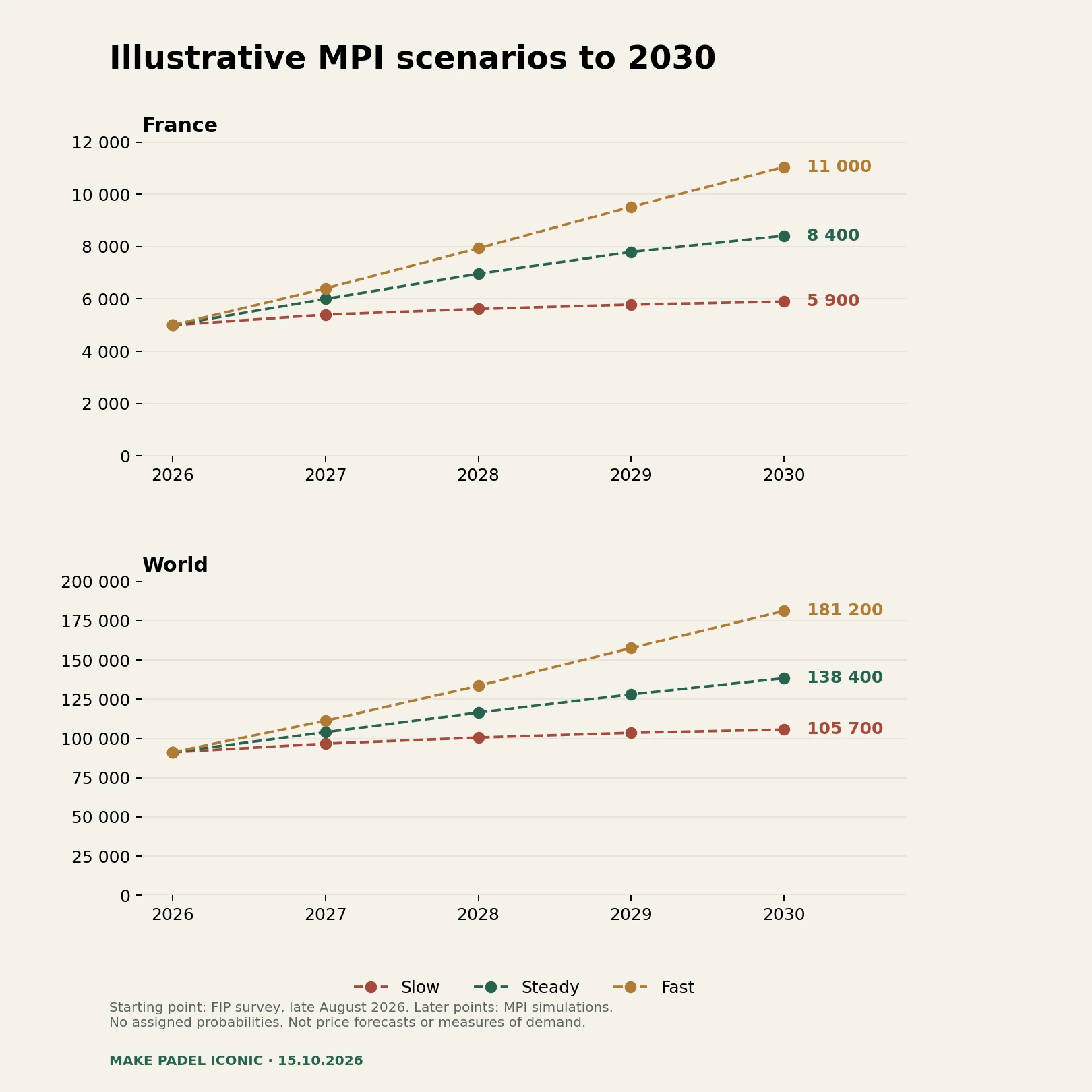
Our illustrative scenarios start from the court stock recorded in August 2026. They reach approximately 5,900, 8,400 or 11,000 French courts by August 2030. Worldwide, the range is roughly 106,000 to 181,000. These are MPI simulations, not FIP forecasts. None predicts prices, attendance or club success.
Broader participation could accompany several of these totals. Location, affordability and who can actually play matter as much as the number. Eleven thousand courts concentrated in the same catchment areas would not provide the same access as a more evenly distributed stock.
France’s most interesting future could be quieter than a succession of openings: a sport close to home, with partners who are easy to find and a price that makes returning possible.
Clubs would have to adapt. For padel, it could mean a lasting place in everyday life. When a game becomes an ordinary habit, the sport has already gained something.
Reading the projections correctly
The supplied pages 68–69 belong to the economic-impact chapter and combine expected infrastructure with estimates of regular players. Their scope and dates differ from the infrastructure survey. They must not be merged into a single observed court count.
The MPI curves assume progressively slower net growth over four twelve-month periods. They illustrate different deployment speeds, without an econometric model or assigned probabilities. A more popular playing culture is a hypothesis about habits and access, not a statistical conclusion of the report.
Download the report
The official FIP PDF and the primary sources used for the Spanish examples are linked below. The report is approximately 39 MB.
Padel can become cheaper to play and occupy more space in people’s lives.